
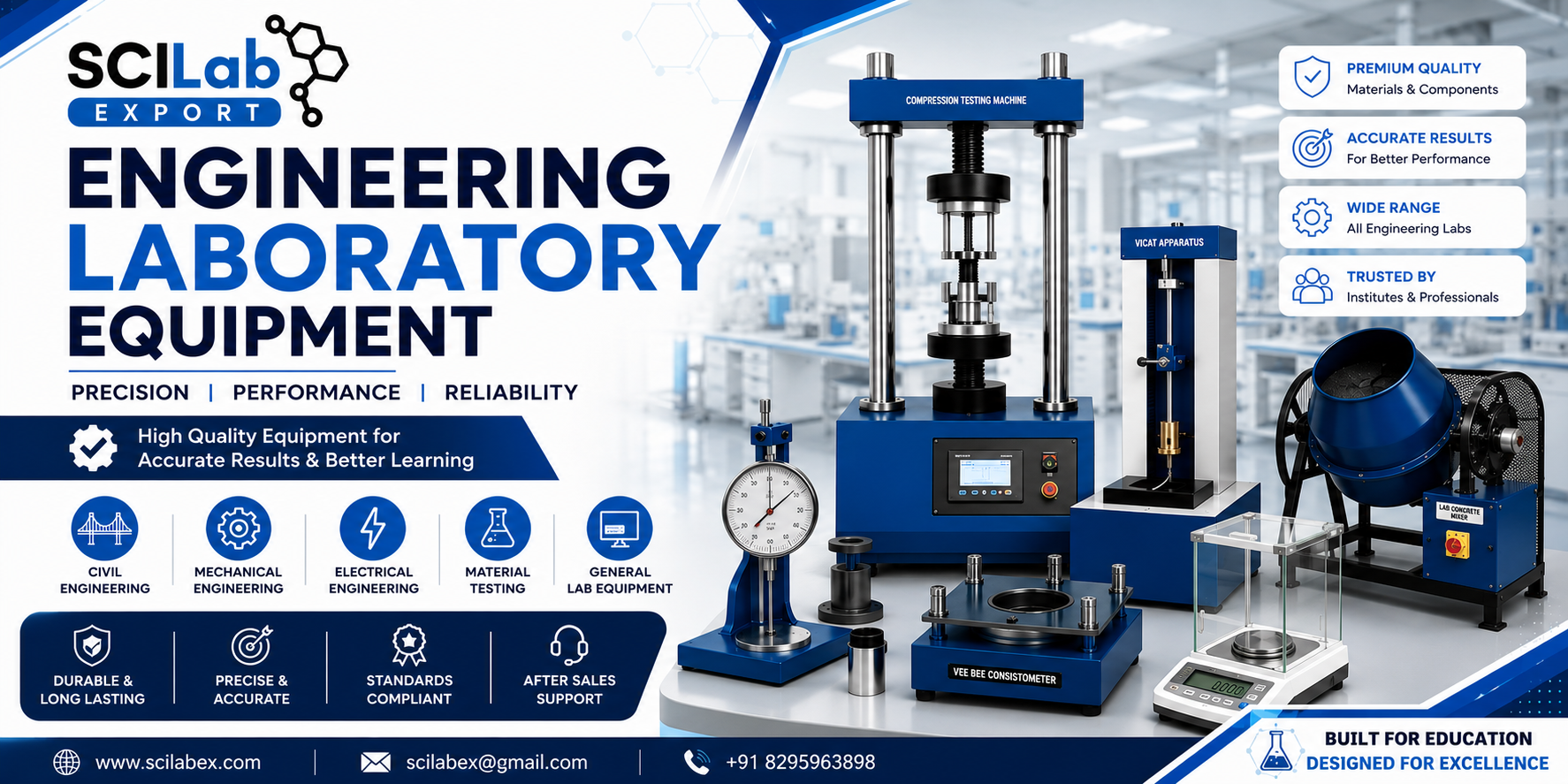
Engineering education and industrial research and development depend heavily on precise, durable, and standardised tools that allow students, researchers, and professionals to test theoretical concepts in a real, hands-on environment. This is exactly where the role of a trusted engineering laboratory equipment manufacturer becomes critical. Whether it is a mechanical engineering lab, a civil engineering lab, an electrical or electronics lab, or a fluid mechanics lab, every department needs equipment that is accurate, safe, and built to withstand years of continuous use.
Science Lab Store is one such name that has built a strong reputation for manufacturing high-quality science and engineering lab equipment that meets international standards. In this blog, we will explore everything about engineering laboratory equipment — what it is, where it is used, which countries use it the most, and why choosing the right manufacturer matters so much for institutions around the world.
What Is Engineering Laboratory Equipment?
Engineering laboratory equipment refers to the wide range of instruments, apparatus, machines, and tools that are used inside technical and engineering laboratories to demonstrate scientific and engineering principles. These tools help students and researchers understand theories through practical experiments rather than just textbook learning.
This equipment is generally divided into different categories based on the engineering discipline it serves:
- Mechanical Engineering Lab Equipment – includes machines for testing the strength of materials, heat engines, fluid mechanics, thermodynamics, and hydraulics.
- Civil Engineering Lab Equipment – includes soil testing kits, concrete testing machines, surveying instruments, and material testing apparatus.
- Electrical and Electronics Lab Equipment – includes power supply units, transformers, motors, oscilloscopes, and circuit training kits.
- Chemical and Environmental Engineering Equipment – includes distillation units, reactors, filtration systems, and water testing kits.
- Automobile Engineering Equipment – includes engine test rigs, transmission models, and vehicle dynamics trainers.
A reliable manufacturer of such tools produces all these categories while ensuring precision, safety, and long-term durability, since this equipment is often used by hundreds of students every year and must withstand heavy daily usage.
Why Engineering Laboratory Equipment Is So Important
Practical knowledge is just as important as theoretical knowledge in engineering education. Without proper laboratory equipment, students cannot fully understand how machines behave under real conditions, how materials react to stress, or how electrical circuits function in practice. This is why universities, polytechnics, vocational training centres, and research institutions invest heavily in laboratory infrastructure.
Good quality lab equipment offers several benefits:
- Accurate Results – Precision instruments give reliable data, which is essential for research and academic assessments.
- Safety for Students – Equipment built with proper safety standards protects students from accidents during experiments.
- Long-Term Durability – Institutions cannot replace equipment every year, so long-lasting build quality is essential.
- Better Understanding of Concepts – Hands-on experiments make it easier to grasp complex engineering theories.
- Industry Readiness – Students trained on modern lab equipment are better prepared for real-world engineering jobs.
Because of these reasons, choosing the right manufacturer is not just a purchasing decision — it is an investment in the quality of education an institution can offer.
Where Is Engineering Laboratory Equipment Used the Most?
While this equipment is used worldwide, certain regions have an especially high demand due to their strong focus on technical education, industrial growth, and research development. Some of the top regions and countries where this equipment is used extensively include:
1. Middle East (UAE, Saudi Arabia, Qatar, Oman, Kuwait)
The Middle East has seen massive investment in technical universities, vocational training institutes, and polytechnic colleges over the past two decades. Countries like the UAE and Saudi Arabia are building world-class engineering campuses, which has significantly increased the demand for imported laboratory equipment.
2. Africa (Nigeria, Kenya, South Africa, Ghana, Ethiopia)
African nations are rapidly expanding their higher education systems, especially in engineering and applied sciences. Universities across these countries regularly import lab equipment to modernise their science and technical departments.
3. Southeast Asia (Malaysia, Indonesia, Philippines, Vietnam)
With growing industrial sectors and a rising number of engineering colleges, Southeast Asian countries are consistently sourcing lab equipment for mechanical, civil, and electrical engineering programmes.
4. Central Asia and CIS Countries (Uzbekistan, Kazakhstan, Tajikistan)
These regions are investing in technical education reforms and require dependable manufacturers who can supply complete laboratory setups for new and renovated institutions.
5. South America (Peru, Colombia, Ecuador, Bolivia)
Many universities and technical institutes in South America are upgrading their laboratories to match international teaching standards, creating consistent demand for imported engineering equipment.
6. European and Eastern European Markets
Smaller technical institutes and vocational training centres in parts of Eastern Europe also look for cost-effective yet high-quality equipment suppliers for their engineering departments.
This global spread shows why an experienced supplier in this field must understand not just the technical specifications but also international shipping, documentation, certification standards, and after-sales support.
Types of Institutions That Require Engineering Lab Equipment
It's not just universities that need this equipment. A wide range of institutions and organisations regularly purchase engineering laboratory tools:
- Government and private engineering colleges
- Polytechnic institutes
- Vocational training centers (TVET institutions)
- Research and development laboratories
- Industrial training institutes (ITIs)
- Technical schools and diploma colleges
- Skill development centers
- Government testing and certification labs
Each of these institutions has slightly different requirements depending on their curriculum, student strength, and available budget, which is why manufacturers need to offer flexible and customisable solutions.
What Makes a Good Engineering Laboratory Equipment Manufacturer?
Not every supplier can be trusted with something as important as laboratory infrastructure. Here are the key qualities that separate a reliable manufacturer from an average one:
1. Precision Engineering
Every instrument must give consistent and accurate readings. Even small errors in calibration can affect research outcomes and student learning.
2. Durable Build Quality
Since laboratory equipment is used by many students daily, it must be built using high-grade materials that can handle continuous use without frequent breakdowns.
3. Compliance with International Standards
A good manufacturer ensures their products meet recognised quality and safety standards, making them acceptable for institutions across different countries.
4. Wide Product Range
Institutions prefer manufacturers who can supply complete laboratory setups rather than dealing with multiple vendors for different equipment categories.
5. Customization Options
Every institution has unique space, curriculum, and budget requirements, so manufacturers should be able to offer tailored solutions.
6. Strong After-Sales Support
Since this is technical equipment, ongoing support, spare parts availability, and installation guidance are extremely important.
7. Export Experience
For international buyers, it is essential that the manufacturer has experience handling export documentation, packaging for long-distance shipping, and international logistics.
About Science Lab Store — A Trusted Name in Lab Equipment Manufacturing
Science Lab Store has established itself as a dependable manufacturer that produces a wide range of science and engineering laboratory equipment for educational institutions across the globe. The company focuses on building durable, precise, and cost-effective equipment designed to meet the practical training needs of engineering students.
From basic classroom-level demonstration kits to advanced research-grade instruments, Science Lab Store manufactures equipment covering mechanical, civil, electrical, and general science laboratories. The company understands that institutions abroad often look for manufacturers who can offer both quality and affordability, along with smooth international delivery.
Some of the key strengths that make Science Lab Store a preferred choice for institutions include:
- A wide catalog covering multiple engineering disciplines
- Equipment built with strong, long-lasting materials
- Competitive pricing suited for institutional budgets
- Experience in fulfilling bulk orders for new laboratory setups
- Reliable packaging and shipping processes for international clients
- Willingness to customize equipment based on curriculum needs
As a growing supplier in this space, Science Lab Store continues to expand its reach into new international markets, helping institutions build laboratories that support strong practical learning experiences for their students.
Common Applications of Engineering Lab Equipment in Real Learning
Beyond simply sitting in a classroom, engineering laboratory equipment plays a direct role in shaping how students apply theory to practice. Here are some real applications where this equipment becomes essential:
- Strength and Material Testing – Students use tensile testing machines, hardness testers, and impact testers to understand how different materials behave under stress, load, or pressure. This is fundamental for civil and mechanical engineering students who will later design bridges, buildings, and machine components.
- Fluid Mechanics and Hydraulics – Equipment like venturi meters, flow measurement apparatus, and pump test rigs help students understand how liquids and gases behave in different systems, which is directly applicable to industries like water treatment, oil and gas, and HVAC.
- Thermodynamics and Heat Transfer – Heat exchanger units, refrigeration trainers, and boiler models allow students to study energy conversion processes that are used across power plants, automotive systems, and industrial machinery.
- Electrical Circuit Analysis – Circuit trainers, power supply units, and measuring instruments such as multimeters and oscilloscopes give electrical engineering students hands-on experience with real circuits before they enter the workforce.
- Surveying and Construction – Total stations, theodolites, and levelling instruments are essential for civil engineering students learning land measurement and construction planning.
- Automobile and Mechatronics Training – Engine cutaway models, transmission trainers, and hydraulic-pneumatic trainers prepare students for careers in automotive design, manufacturing, and maintenance.
Each of these applications highlights why institutions cannot compromise on the quality of the equipment they purchase. Poorly built instruments not only give inaccurate results but can also become a safety hazard over time, especially when used repeatedly by large batches of students.
The Growing Global Demand for Engineering Lab Equipment
Technical education is expanding faster than ever before, particularly in developing economies where governments are investing heavily in skill development and vocational training. As more polytechnics, engineering colleges, and TVET centres are established across the Middle East, Africa, Southeast Asia, and South America, the need for well-equipped laboratories continues to rise year after year.
This growth is also being driven by:
- Rising enrollment in engineering and technical diploma programs
- Government initiatives promoting STEM and vocational education
- Increased private investment in university infrastructure
- A shift toward practical, skill-based learning instead of purely theoretical education
- Modernization of older laboratories with updated, safer equipment
For institutions in these growing markets, partnering with an experienced manufacturer that understands both technical requirements and international logistics makes the entire procurement process much smoother.
Frequently Asked Questions
1. What is the difference between science lab equipment and engineering lab equipment? Science lab equipment generally covers physics, chemistry, and biology instruments used for general science education, while engineering laboratory equipment is more specialised, covering mechanical, civil, electrical, and other technical disciplines used specifically in engineering programmes.
2. Can lab equipment be customised for a specific curriculum? Yes, most experienced manufacturers, including Science Lab Store, offer customisation based on the syllabus, available lab space, and budget of the institution.
3. How long does engineering laboratory equipment typically last? With proper maintenance, high-quality equipment built from durable materials can last well over a decade, even with heavy daily use by students.
4. Do manufacturers provide installation and training support? Reliable manufacturers usually offer installation guidance, operational training, and ongoing technical support to ensure institutions get the most out of their equipment.
5. Is it cost-effective for international institutions to import lab equipment? Yes, many institutions outside India find it more cost-effective to import equipment from experienced manufacturers who offer competitive pricing, bulk order discounts, and reliable international shipping, compared to sourcing locally at a higher cost.
How to Choose the Right Equipment Supplier for Your Institution
If you are responsible for setting up or upgrading an engineering laboratory, here are a few practical tips to help you choose the right manufacturer:
- Check Product Range – Make sure the manufacturer covers all the equipment categories your department needs.
- Ask for Technical Specifications – Always review detailed specifications before finalising an order.
- Request Sample Images or Videos – This helps you understand the actual build quality before shipment.
- Confirm Export Experience – Choose manufacturers who have prior experience shipping to your country or region.
- Compare Pricing with Quality – The cheapest option is not always the best; balance cost with durability and accuracy.
- Check Warranty and Support Terms – Understand what kind of support you will receive after installation.
Final Thoughts
Setting up a well-equipped engineering laboratory is one of the most important investments an educational institution can make. It directly affects the quality of practical training students receive and how well-prepared they are for real industry challenges. Choosing the right engineering laboratory equipment manufacturer ensures that institutions get accurate, safe, and long-lasting equipment that supports effective learning for years to come.
With a strong focus on quality, variety, and international service, Science Lab Store continues to support engineering colleges, polytechnics, and technical institutes across different countries by supplying dependable laboratory equipment designed for real practical learning. As global demand for technical education continues to grow, manufacturers like Science Lab Store play a vital role in helping institutions build stronger, better-equipped engineering laboratories for the future.

Leave a comment